Anyone offering coaching today works in a market that did not exist in this form ten years ago. Digital platforms, AI-supported reflection tools, in-house coaching pools, international providers with standardised packages: in 2016, all of this was a fringe phenomenon at best. The obvious question, then, is what our profession will look like in another ten years.
The International Coaching Federation has given a remarkably honest answer to this question. The 2026 ICF Coaching Futures Report does not deliver a forecast. It delivers four scenarios. And that is exactly what makes it useful in practice.
Why Scenarios Are Worth More Than Forecasts
Forecasts create a false sense of certainty. They extrapolate the present and regularly overlook the very disruptions that matter. Scenario planning takes a different approach: it identifies the forces that change a field and describes the plausible futures that result from them.
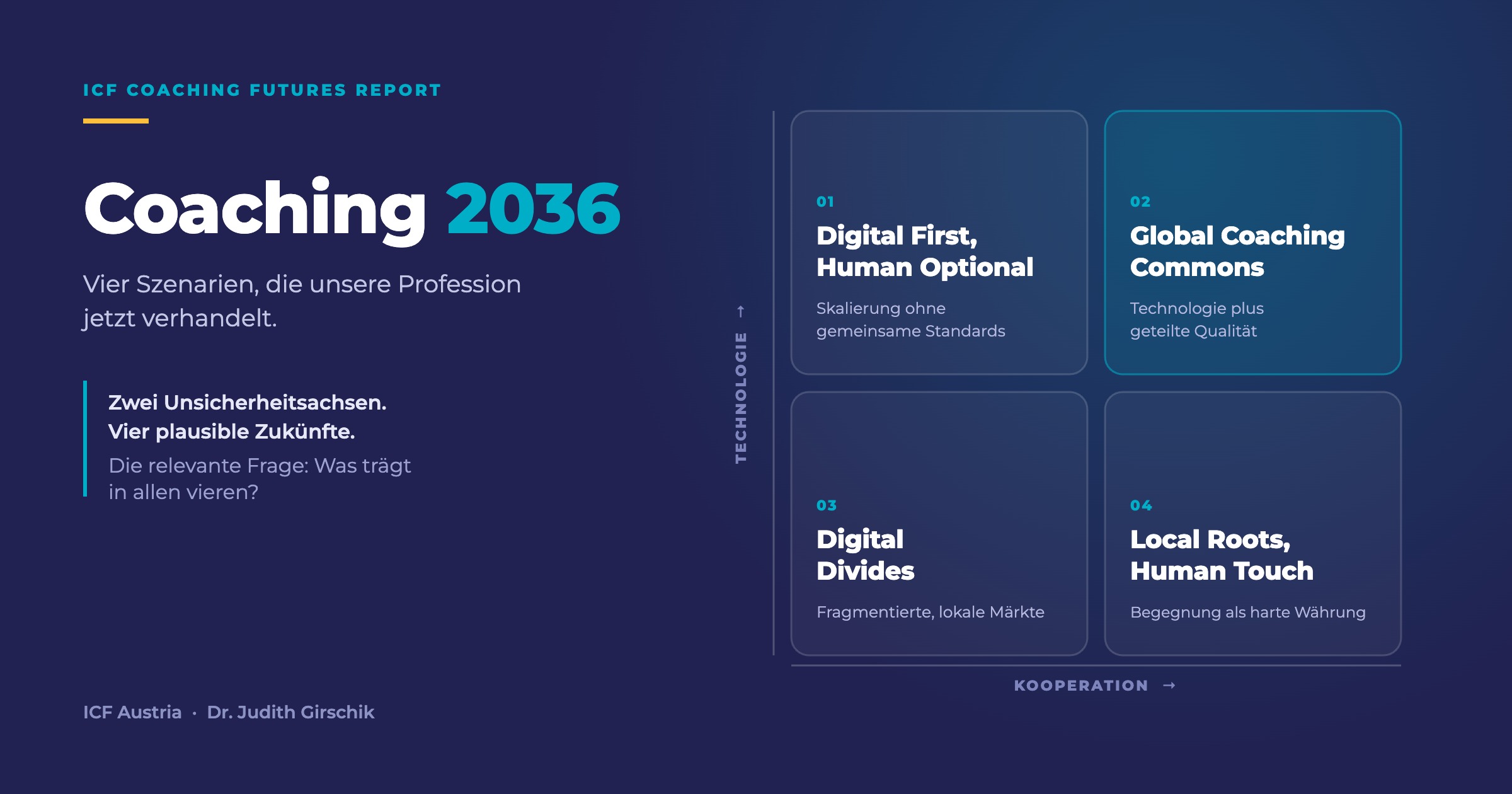
The ICF report works with two axes of uncertainty. First: how far does technology penetrate coaching practice? Second: does the profession cooperate globally or fragment along national and economic lines? Combining the two produces four futures for the year 2036.
The Five Drivers of Change
Before developing the scenarios, the report names five forces that set the frame:
- Collaboration across ecosystems. Coaching no longer stands alone but works in concert with organisational development, HR technology, healthcare and education.
- Shifts in work and the economy. Project-based careers, hybrid leadership and economic volatility change what clients seek coaching for in the first place.
- Technological acceleration. Scalability and new routes of access, coupled with the question of what can be supported by machines and what cannot.
- Growing cultural awareness. What counts as good coaching practice in Vienna does not automatically translate to Singapore or São Paulo.
- Rising expectations of standards and trust. The bigger the market, the more pressing the question of how clients recognise quality.
The Four Scenarios for 2036
Digital First, Human Optional. High technology, low cooperation. Coaching scales through platforms and AI assistants while geopolitical tensions distribute access unevenly. Coaches operate in permanent ethical grey zones and compete with systems that are cheaper and faster.
Global Coaching Commons. High technology, high cooperation. Technology is a natural part of practice, and shared standards make quality comparable internationally. Coaches work in hybrid ways and become partners in development processes that reach far beyond the individual.
Digital Divides. Low technology, low cooperation. Markets seal themselves off, and scepticism towards digital solutions remains high. Coaching stays personal and local, but access and impact drift far apart from region to region.
Local Roots, Human Touch. Low technology, high cooperation. The longing for genuine encounter prevails, and international collaboration strengthens local and community-based models. Trust and relationship are the hard currency.
None of these scenarios is a wish or a warning. Each is plausible. And in each of them, the answer to what distinguishes professional coaching looks different.
What This Means for the Austrian Market
Western Europe accounts for around a quarter of all coaches worldwide, as the ICF Global Coaching Study 2025 shows. The Austrian market is small but demanding, with a high share of executive coaching and a pronounced sensitivity to qualifications. I consider three points particularly relevant for us here.
First: the technology question has already been decided, only its shape has not. Digital coaching platforms have arrived in Austrian corporations. The strategic question is not whether we work with them, but at which point in the process human support is irreplaceable and how we demonstrate that.
Second: trust becomes the differentiator, not reach. In a market without a legally protected professional title, a verifiable credential is the only reliable signal clients have before booking. That is exactly what the ICF credentials ACC, PCC and MCC and the Coach Finder of ICF Austria stand for. The more providers push into the market, the more weight this signal carries.
Third: the work of the association is shifting. A professional association that merely administers memberships is not needed in any of the four scenarios. What is needed is one that enforces standards, as we do with the ICF Code of Ethics, organises continuing education and explains to the public what coaching does and what it does not do.
Five Recommendations the Report Derives from This
The ICF report closes with five directions for action that hold up in all four scenarios:
- Foster collaboration and shared learning
- Focus on systemic well-being
- Use technology for human connection, not against it
- Develop culturally responsive practices
- Allow diverse pathways to professional excellence
At first this sounds general. Translated into your own practice, it becomes a concrete exercise: which of my current decisions about positioning, continuing education and tools hold up in all four scenarios? Anything that only works in one of them is a bet.
Our Conclusion
In my work with executives, I regularly see how much energy goes into the search for the one correct assumption about the future. It is mostly wasted. Robust decisions emerge where you hold several futures side by side and test what holds up in all of them.
For our profession this means: the discussion about AI in coaching is important, but it is not the decisive one. What is decisive is whether we succeed in making quality verifiable and in remaining internationally connected. The report puts it this way: the future of coaching is not something we wait for. It is something we shape.
That is precisely the task of a professional association, and that is precisely what we are working on at ICF Austria.
Sources
- International Coaching Federation (2026). 2026 ICF Coaching Futures Report: Envisioning Coaching’s Next Horizon. icfcoachingfuturesreport.com
- International Coaching Federation (2026). Four Scenarios from the 2026 ICF Coaching Futures Report.
- International Coaching Federation (2026). The Drivers of Change Shaping the Future of Coaching.
- International Coaching Federation (2025). ICF Global Coaching Study 2025, Executive Summary.
By Dr. Judith Girschik, Vice President of ICF Austria