Can artificial intelligence coach? And if so, what does this mean for the future of a profession whose foundation is the human relationship?
A leader is sitting in front of her laptop in the evening. A difficult conversation is behind her. She feels uncertain, is frustrated by her own reaction and wants to sort through her thoughts. Instead of contacting a coach, she opens an AI application. She describes the situation, receives questions, reflects on possible courses of action and develops a new perspective within minutes. In the end, she feels clearer.
Was that already coaching?
The question is no longer merely theoretical. Artificial intelligence is changing the way people learn, prepare decisions and reflect on themselves. In doing so, it touches on a core area of professional coaching: supporting human development and reflection processes. For the coaching profession, this creates opportunities, but also fundamental questions about quality, responsibility and the value of human relationships.
When technology begins to ask good questions
For a long time, the ability to open up new perspectives through targeted questions was considered a particular strength of professional coaches. Today, AI systems can formulate questions, structure conversations, encourage changes in perspective and support people in reflecting on their experiences. They are available almost anytime, easily accessible and can accompany development processes between personal coaching sessions.
This is a development with considerable potential. Particularly in organisations where individual coaching services have so far been available only to a limited group of people, AI could help make opportunities for reflection more widely accessible. However, this gives rise to an important distinction:
Asking a helpful question is not automatically the same as professional coaching.
Coaching is not limited to a sequence of insightful questions. It also involves consciously creating a supportive working relationship, noticing subtle nuances, reflecting on one’s own assumptions and being able to accompany people in complex and often contradictory situations. This is precisely where the discussion about AI becomes particularly interesting.
What can AI do – and where are its limits?
Imagine a leader reporting on a conflict within their team. An AI system can help examine the situation from different perspectives. It can formulate questions, make possible interests visible and support the preparation of an upcoming conversation. A professional coach also works with questions and changes in perspective. Beyond that, however, the coach creates a relational space in which uncertainty, emotional ambivalence, unspoken expectations and personal patterns can be explored. A hesitation, a change in tone of voice or an unexpected emotional moment may provide an opportunity to pause and take a closer look together.
AI can analyse and respond to linguistic signals and, depending on the system, other signals as well. However, whether it can achieve the same quality of relationship and the same mechanisms of impact as human coaching has not yet been conclusively established.
This does not mean that AI is fundamentally unsuitable for supporting development processes. Rather, it means that we should make more careful distinctions:
- When is the aim to structure thoughts and information?
- When is it to reflect on individual courses of action?
- When are we dealing with complex personal or organisational dynamics?
- And when is a human being explicitly needed to take responsibility within a professional relationship?
The more carefully we answer these questions, the more effectively we can use technology.
The real challenge is not technological, but professional
The use of AI also changes the responsibilities of coaches. Anyone using AI must understand what the systems they employ can achieve, where their limitations lie and what risks may arise. A seemingly harmless example illustrates this: A coach wants to simplify the documentation of coaching sessions and uses an AI system to summarise confidential session notes. Technically, this may work extremely well. But have the clients been informed? Is the processing of their data adequately protected? What happens to the information entered? And what would the consequences be if sensitive information became accessible to unauthorised parties? This makes one thing clear: Technological possibilities alone do not answer ethical questions.
Not everything that is technically possible is also responsible in professional coaching.
For coaches, it is therefore not simply a matter of learning how to use new tools. It is about continuing to develop their own professional mindset under changing conditions.
ICF Provides Guidance: Standards for the Responsible Use of AI
The International Coaching Federation (ICF) is actively addressing the impact of artificial intelligence on the coaching profession. With the ICF Artificial Intelligence (AI) Coaching Framework and Standards, it has developed a framework for guidance that takes into account both the opportunities and risks of AI-supported coaching applications. The framework covers six areas:
- Ethical Foundations: Transparency, responsible conduct and clarity about the possibilities and limitations of AI.
- Designing the Coaching Relationship: Agreements, trust and safety when interacting with AI systems.
- Effective Communication: The quality of dialogue and support for reflection processes.
- Learning and Development: The ability of AI applications to meaningfully support individual development processes.
- Quality Assurance and Evaluation: Requirements for reliability, effectiveness and the evaluation of systems used.
- Technological Foundations: In particular, data protection, data security and accessibility.
In addition, the ICF Code of Ethics makes it clear that the ethical responsibility of ICF Professionals also extends to the technological systems they use, including artificial intelligence. In this way, ICF makes an important contribution to the professionalisation of a field in which technological innovation and established quality standards are increasingly coming together. The aim is not to prevent innovation. Rather, it is to shape innovation in a way that keeps the interests, rights and development of clients at the centre.
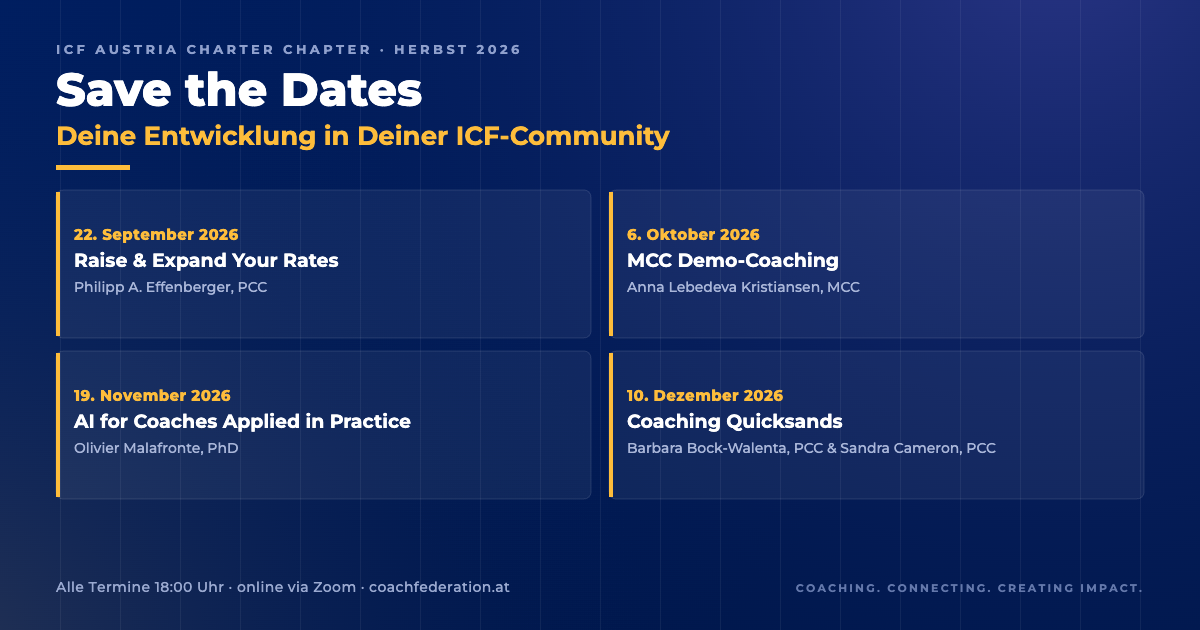
Experiencing AI in coaching ind our upcoming event “AI for Coaches applied in Practice”
How can the possibilities of artificial intelligence be integrated into coaching practice in a concrete and responsible way? We will explore this question on 19 November 2026 at our ICF Austria event “AI for Coaches Applied in Practice” with Oliver Malafronte, PhD. Together, we will focus on the practical application of AI in coaching and explore how technological innovation and professional coaching competence can work together meaningfully. The event offers an opportunity to take the ideas presented in this article further and engage with the opportunities and challenges of AI for one’s own coaching practice.
Datum: 19 November 2026
Speaker: Oliver Malafronte, PhD
Event: AI for Coaches Applied in Practice
Please save the date. We look forward to an inspiring exchange and to shaping the future of professional coaching together.
Three questions every coach should ask themselves
This development gives rise to three central questions for reflection on one’s own coaching practice.
1. Where does AI create real added value?
Not every new application automatically improves the quality of a coaching process. What matters is whether it provides concrete benefits to clients, for example by helping them prepare, structure or deepen their reflection.
2. Which responsibilities can and must I not delegate to technology?
Reviewing data protection, clarifying confidentiality and transparency, and professionally assessing the limitations of the tools used remain essential responsibilities of coaches.
3. What characterises my own professional effectiveness?
As AI becomes increasingly capable of asking helpful questions, reflecting on one’s own coaching mindset becomes even more important.
So: How do I build trust? How do I reflect on my own assumptions? How do I deal with complexity, contradictions and uncertainty? And how do I recognise whether my coaching actually creates added value?
These questions concern more than our methods. They concern our understanding of ourselves as a profession.
Competition or complement? That may be the wrong question.
The discussion about AI is often framed around two positions: Either technology is seen as a threat to human coaching or it is celebrated as an almost unlimited opportunity. Both perspectives fall short.
AI will take over certain tasks that have previously been performed by coaches. It can enable new, easily accessible services and may also change clients’ expectations. At the same time, human coaches will continue to be challenged to clearly demonstrate their specific competence, effectiveness and professional added value.
The future will therefore probably be shaped less by a simple either-or choice than by the question of how human and technological capabilities can work together meaningfully. This requires openness to innovation, but also a willingness to recognise limitations and critically examine existing practices.
The future of professional coaching begins with our mindset
Artificial intelligence may ultimately confront us with a much more fundamental question than that of its technical capabilities:
What defines professional coaching at its core – and how do people recognise its quality?
A strong profession is not characterised by resisting change. It continues to evolve, examines its own assumptions and remains committed to its fundamental values.
For ICF Austria, this means actively contributing to the dialogue about the future of coaching: critically, openly and on the basis of professional standards.
Because the decisive question is not only what AI will be capable of in the future.
What matters is how responsibly we, as a profession, deal with these possibilities.
Further Information
- ICF Artificial Intelligence (AI) Coaching Framework and Standards: https://coachingfederation.org/resource/icf-artificial-intelligence-ai-coaching-framework-and-standards/
- ICF Practical Guide to Integrating AI and Coaching: https://coachingfederation.org/resource/icf-artificial-intelligence-coaching-standards-a-practical-guide-to-integrating-ai-and-coaching/
- ICF Code of Ethics: https://coachingfederation.org/credentialing/coaching-ethics/icf-code-of-ethics/
How are you already using AI in your coaching practice? And where do you see the limits of technological support?
ICF Austria invites you to reflect on these questions together and actively contribute to the continued development of our profession: office@coachfederation.at